How Exponential Technologies Stand to Change Capitalism
Advances in technology have almost always spurred change in human society. Whether it was the agricultural revolution that disrupted the hunter-gatherer lifestyle of human beings ~10,000 years ago; the industrial revolution that increased globalization ~300 years ago; or, more recently, the internet revolution that transformed almost everything in our world, from transport and communications to healthcare and retail. Time and time again, there have come technologies that have changed society in irreversible ways.
In line with that trend, new technologies on the horizon — specifically the exponential kind viz. clean energy, artificial intelligence, and 3-D printing — may change how we live, and force us to rethink the rules of modern-day economics and capitalism. I’d like to examine how and why.
To do this, I’ll first visit some fundamental questions about economics. Then I’ll share my view on what these exponential technologies are and how they stand to change the levers on which capitalism works. At the end of my argument, I’ll outline broad steps you can take today to position yourself to ride the rising wave tomorrow.
Basic Economic Questions
How Humans Cooperate
Why does money exist at all?
There’s nothing too profound about the answer: It’s a tool that serves as a common denominator of value for both natural resources and human labor. That is to say, it allows people to exchange resources and their time more effectively.
Money by itself is not valuable. It is the resources that you can use money to buy that are. Money, as it were, is only the medium. Even though obvious sounding, this subtle quality about money is what is profound about it.
It’s like language. If I don’t understand English, a conversation in English will be meaningless to me. It is only when interlocutors understand English can they use it to convey expression, emotion, and meaning, thereby adding value to each other.
It is therefore because everyone in society agrees — through government — that ₹500 and $10 carry that much value, that I can use ₹500 and $10 to buy that much worth of stuff. If I woke up tomorrow and the world had changed, and people had suddenly begun using another system to measure value in place of rupees and dollars, my ₹500 and $10 would be worthless.
Naturally over the centuries we have also tried to figure out how best to manage money in the context of how it will best serve the needs of society.
Should the community collectively be in charge of money and manage resources that way? Communism and socialism tried to answer that question.
Perhaps individuals should be guided by self-interest as they trade with each other in a market-based system. Capitalism and libertarianism have been attempts at that approach.
Scarcity (vis-a-vis Abundance)
Whatever the system may be, economic systems work because resources on planet Earth are limited.
Imagine a world where you have unlimited resources at your disposal, a world where you can get whatever you want instantaneously without effort, by simply desiring for it. Would you need money in such a world? Probably not.
It is therefore scarcity that drives the need to have economic systems so that we can value and distribute Earth’s finite resources among each other in a consistent way.
Capitalism 101
Capitalism has arguably been one of our most successful experiments to do this.
The general overview of how the system works is that investors (capitalists) use their money to purchase equipment and facilities (capital) and human time and effort (labor) to produce goods and services (output).
If those goods and services are sold at prices higher than the costs of equipment and labor, then investors make profits.
And profits are mostly circulated back to either operations or research & development (R&D) to generate more output in the future.
Technology and Capitalism
The genius of capitalism has been that it has incentivized humans to seek knowledge. The more knowledge we sought, the more technology we invented, the more output was generated, the more the economic pool expanded, and the more the investors made profits.
Think of how something as straightforward as transport has evolved under this system:
- Land transport (from being reliant on our bipedal ability and domesticating animals like horses, to building cars and railway systems, to developing Hyperloop travel systems today);
- Water transport (from being afraid of uncharted waters, to creating makeshift boats, to developing ships, to then manufacturing extremely sophisticated commercial and naval vessels);
- Air transport (from Wright-Brothers-era aviation technology, to the jet- and supersonic-ages);
- And even space transport today (from rudimentary astronomical analyses, to complex analyses with telescopes, to spaceships developed by national governments, to the exploration conducted by private corporations such as SpaceX and Blue Origin today).
Along the way, the safety, reliability, efficiency, and speed of travel have all improved. And traveling — whether on roads, the seas, by air, or in space — has gone on to unlock more economic value for all (think of how it has spurred trade, globalization, development of satellite communications, etc).
Because money is the common denominator to value the economic benefit of all these advances, the overall pool of economic value expanded. (That has also allowed for larger and larger amounts of profit-making.)
Exponential Technologies
Abundance (vis-a-vis Scarcity)
Unlimited clean energy, artificial intelligence, and 3-D printing — all technologies created by profit-seeking investors — are technologies that are likely to bring us closer to an era of global abundance. There may soon come a time where you could:
- Have intelligent robots do all of your work for you (like troubleshoot and repair any problems with your localized energy system, drive your car, work on your farm, clean your house, be your personalized doctor, etc.);
- Have a 3-D printer system that you can use to print any object you desire (from simple things like clothes, lamps, and other everyday objects to eventually complex things like food, medicines, and even your car and house!);
- Generate more energy than you need on or near your house and be able to store it efficiently; and then use it to power those robots, data-centers, and 3-D printing systems.
Even if things don’t unfold in this exact manner, in a world where some version of all of the above is possible, we will be able to for the first time in the history of our existence escape the rut of everyday mundane work (including at the office). And hopefully focus on what should matter most to us — our passions, true interests, and philosophy.
Consider what one of the most distinguished economists in history, John Maynard Keynes, had to say about this a hundred years ago:
A point may soon be reached, much sooner perhaps than we are all of us aware of, when these [economic] needs are satisfied in the sense that we prefer to devote our further energies to non-economic purposes.
Marginal Costs
It’s important to understand the idea of traversing as a species from a world of scarcity to a world of abundance. So here’s another thought experiment: Why don’t we produce everything we buy for ourselves on our own? Theoretically speaking we could, but imagine how many steps it would take for a person like me to make just a simple cup of coffee for myself (and I don’t even like coffee that much):
- First, I’d need to cultivate my own coffee beans (for which I’d need land, seeds, fertilizers, water, and time to cultivate the land);
- Then, I’d need to create clay, or glass, to make my china;
- I’d also need to domesticate a cow for milk and feed it grass and make sure it is healthy;
- If I have somewhat of a sweet tooth, which I do, I’d have to process my own sugar or honey;
- Once the crop is ready, I’d also need to grind the coffee beans manually;
- I’d need to gather wood to make a fire so that I can boil water (water, that I’d have to fetch on my own from the nearest well);
- Finally, I’d bring all of these things together and come to the point of making coffee.
The cost of doing this in terms of time, resources, and energy, would be ridiculously high. I am better off ordering a coffee-maker on Amazon, buying the beans, milk, and honey from the nearest grocery store, and then going on to prepare coffee at home; or better yet, paying a café like Starbucks a reasonable amount of money to prepare my cuppa as I get to work in the morning.
In other words, the marginal cost — the cost added by producing one extra item of a good — of producing any item from start-to-finish on my own is extremely high today. Therefore, instead of producing everything I need on my own, I purchase things from the market where I optimize on marginal costs. Assuming that I don’t get ripped off on profit margins, I buy coffee from the person who has the lowest marginal cost of producing coffee; I buy glass from the person who has the lowest marginal cost of producing glass; and so on.
With 3-D Printing…
…the marginal cost of producing most goods locally, or even at home, will get closer and closer to zero — not zero itself, but pretty close to it. For the example above, all I’d need to do is download the coffee recipe 3-D printing file from the internet, pass the command onto my 3-D printer, and have my coffee ready in minutes, if not seconds.
Will that be enough to print coffee? What about the 3-D printing ink? Will 3-D machines be versatile enough to process different chemicals and compounds to allow for a wide variety of localized production?
In one sense, these questions highlight the limitations of what we can and cannot do using 3-D printers. Since 3-D printing production would require some base materials for input, and those materials would be obtained from a limited pool of natural resources on this planet, we fundamentally won’t live in an infinite world — and that is not my claim either. What I’m saying is that we’ll live in an abundant world where we can produce everything we need at next-to-nothing — but not zero — marginal costs.
The marginal cost of producing coffee at home using a 3-D printer would be less than or equal to the marginal cost of production for a coffee vendor— and that would be enough to change the economics of localized production.
As for whether 3-D printers could accommodate varied production, the answer is yes, they will be able to — varied, cheap, quality localized production using 3-D printers will be feasible.
For the things that can’t be feasibly 3-D Printed due to size…
…like large ships, huge buildings, airplanes, etc., the manufacturing process will be outsourced to factories managed almost entirely by intelligent robots (or perhaps hybrids of robots and 3-D printers). These robots will work tirelessly, 24/7, with perfection, and outside of labor unions — all the while being powered by an endless supply of clean energy. (These exponential technologies will all tie into each other.)
Automated Products
Not only would the production processes be automated, but the very products being manufactured will be automated too. So for example not only would the process of building ships be automated, ships themselves would be autonomous machines.
It would be like one intelligent machine giving birth to another intelligent machine.
Consider this example from Rolls Royce on the future of the shipping industry. RR is developing an autonomous ship that would not require human sailors and engineers on-board, and plans to release this product by the turn of this decade.
In fact, drivers in America and the West are already waiting for companies like Uber, Tesla, Alphabet, and Apple — and I haven’t even mentioned the core automobile industry’s catch-up to this tech — to commercially launch on-demand autonomous-car services. Very soon, consumers will not only not need to own cars, they will not need other humans to drive their cars either. They will be able to simply pull out their phones, open the respective apps, set pick-up and drop-off points, and have the robots do the rest of the work. Since the cars would be powered by dirt-cheap clean energy and would have no labor costs of driving attached to them, the cost of vehicular transportation will plummet. Consider what Uber CEO Travis Kalanick had to say about this back in 2014:
When there’s no other dude in the car, the cost of taking an Uber anywhere becomes cheaper than owning a vehicle.
And Tesla CEO Elon Musk, who made this statement only a few days ago, in July 2016:
When true self-driving is approved by regulators, it will mean that you will be able to summon your Tesla from pretty much anywhere. Once it picks you up, you will be able to sleep, read or do anything else enroute to your destination.
You will also be able to add your car to the Tesla shared fleet just by tapping a button on the Tesla phone app and have it generate income for you while you’re at work or on vacation, significantly offsetting and at times potentially exceeding the monthly loan or lease cost. In cities where demand exceeds the supply of customer-owned cars, Tesla will operate its own fleet.
In all these cases, the end products are independent, intelligent machines; I’m not sure of their production processes yet, but I’m quite positive they are not entirely automated just yet. With the way things are moving, though, that will happen soon too.
The Science behind Machine Learning
What makes these robots truly intelligent is a combination of high processing power and the heuristic ability that allows them to learn on the job with minimal human supervision — a technique called machine learning.
Machine learning algorithms allow systems to process extremely large datasets and, through the process of trial and error, make sense of those datasets. Let me give you two examples to illustrate this point: One of chess, and one of visuals.
In the case of chess, high processing power can allow a computer, without any prior experience in the game of chess, to conduct millions of simulations of the game in a matter of a couple of hours. The results of these simulations are captured in a dataset. With some initially programmed rules — i.e. the King piece needs to be protected, how the pieces move, etc. — the system is able to digest and analyze that information to learn how the game of chess evolves with each passing move. It can figure out the optimal set of moves and response-moves based on its experience from playing those millions of rounds; and it continuously improves its understanding with each passing game it plays with an opponent and/or simulates on its own.
The adage practice makes perfect is at play here. But instead of taking years to master chess, the computer can do it tirelessly in a matter of a few hours, if not less.
Chess-master computers have existed since 1997, to be sure. What has changed today though is that the processing power of computers has multiplied many times over, giving them the ability to apply the heuristic logic to much more complex fields.
Consider the case of visual learning in machines. A machine-learning algorithm can analyze millions of images — something it didn’t have the processing power to do quickly in 1997 — and begin to make sense of what arrangement of pixels is likely to depict what object. If I feed such an algorithm with millions of images of cats (by linking it to search results from Google Images), and set the rule at the beginning that it’s looking at cat images, the algorithm can begin to make determinations of what arrangements of pixels form the shape of (what we humans consider) a cat. It can then apply this logic to discern other patterns with extremely high accuracy.
Embedded with a camera and some initially programmed rules, a robot can now move around and process what it’s seeing in the real-world, learn new patterns, and make some sense of this world.
This ability to learn and iterate is translatable to other applications and can allow robots to work on farmlands, in factories, in complex industrial plants, in airports, and even in offices to do knowledge work — all of which were once regarded as the sole domains of human expertise and skill.
It’s no longer difficult for artificially intelligent computer systems to write reports, do in-depth legal research, do marketing-related tasks, and even make managerial decisions. And savvy tech companies are leading the way ondeveloping these technologies further.
Experience from History
Asit has happened through history, technological innovation has almost always disrupted labor markets in the short-run. But equally so, it has created new industries and more jobs for labor in the long-run.
The internet, for example, disrupted many businesses and killed many jobs in the short-run — Netflix disrupted Blockbuster, Expedia-type tech companies disrupted brick-and-mortar travel agencies, and so on.
But the internet also enabled the creation of many new industries that in turn created many more new jobs in the long-run — search, social media, social media marketing, video streaming, instant communication, the sharing economy, etc.
With Exponential Technologies, outcomes can be different
This time, though, technological innovation may propel humankind through the border gates between scarcity and abundance. If you can 3-D print anything you desire from the comfort of your home, at a next-to-nothing cost to you, and be serviced by robots powered by unlimited clean energy, the entire model of capitalism can lose essence. People would become prosumers — producing everything they want to consume on their own — instead of pure consumers. There would be little need for human labor.
Even Paul Krugman, noted New York Times columnist and recipient of the Nobel Prize for Economics, has rung alarm bells:
Today a much darker picture of the effects of technology on labor is emerging. In this picture, highly educated workers are as likely as less educated workers to find themselves displaced and devalued…
The Absurdity in terms of Capital and Labor
How are exponential technologies changing the dynamics of capitalism?
Traditionally, part of the income generated from goods and services has gone to owners of capital — investors — and part of it has gone to the workers — labor. If we move on to a version of capitalism where machines do most if not all our work for us, how would human labor derive any meaningful proportion of income at all?
Typically, in a society with a strong middle class, roughly 70% of income goes to labor, and 30% to owners of capital. Consider ~200 years worth of data from Britain and France for reference:

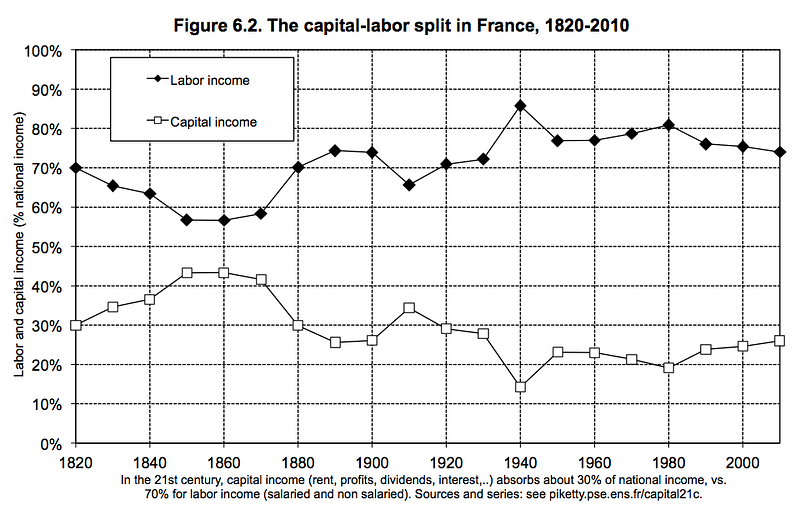
If capital is able to produce goods and services without labor, larger and larger shares of income will go to the owners of capital. And at some point — the more this happens across more industries — the capitalistic system will just not work.
Let’s revisit the autonomous car example. At the moment, most of Uber’s revenue (income) goes to pay for its main cost, its drivers. Since Uber is not a public company and therefore information on its financials is not available, let’s just assume 30% of the revenue that Uber generates goes back to its investors and 70% of it is used to pay the human drivers their works’s worth. If all of Uber’s cars become driverless, near 100% of the revenue generated would go back to its investors (and the tiny balance would be used to pay the very few skilled engineers who would write and maintain the algorithms that would run the Uber system. With machine learning, though, even those jobs could be taken over by intelligent robots who can write and modify algorithms on their own).
It’s already happening…
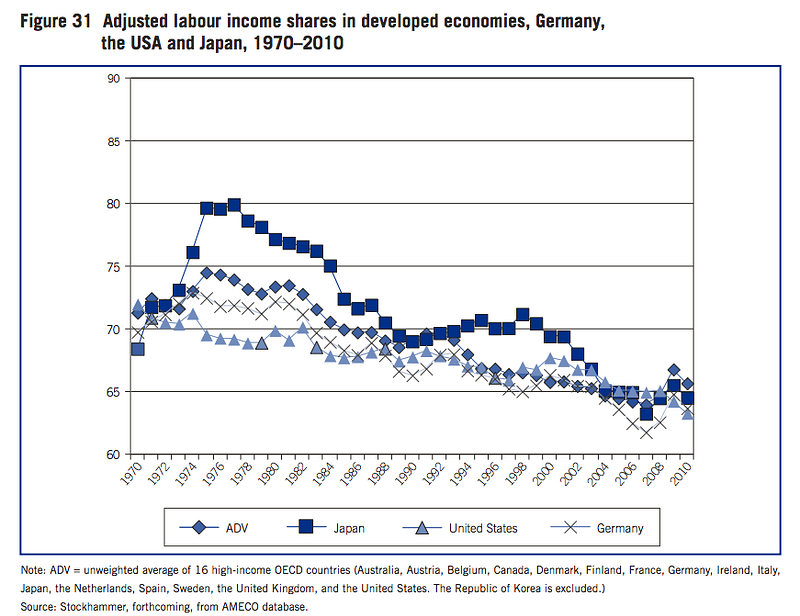
The concentration of wealth in the hands of the owners of capital is already happening. It’s happened before too, to be sure, as you saw from the data above for Britain and France (see the graphs above for around 1850); and no doubt that the current concentration of income in the hands of capital owners can be attributed to other reasons like oligarchy, corruption in political processes, inefficient taxation policy, cronyism, elitism, lack of quality education, lack of upward mobility, etc. But for the reasons outlined in this essay, things may be different this time around.
So peruse data published by the International Labor Organization on a pool of advanced economies where the share of income going to labor is already on the decline. It is already less than 65% in the case of Germany, Japan, and the United States as of 2010. See below:
100% income to capital?
Asoutlined in the Uber example, exponential technologies can theoretically take society to a point where owners of capital could obtain near 100% of the share of income because the machines they own would do all economic work. The very envisaging of this scenario would imply the realization of Keynes’s prediction from 100-years ago.
Political Transitions
The easy part is to imagine a post-capitalist society of abundance where we are assisted by a range of exponential technologies and can focus on our passions and interests.
The biggest barrier to this future, though, will be the point of transition. How do we move 7+ billion people from one system to another with limited upheaval?
Who also decides what qualifies as limited? If a billion people left behind end up dying in despair, instead of two billion people, will that be considered limited? Who balances and adjudicates between idealism, pragmatism, and reality? All important but at the moment unanswered questions.
Since this inflection point may render a very significant percentage of our species economically useless, the entire subject needs to be treated with extreme sensitivity. If not handled deftly, the transition could lead to civil unrest, civil war, xenophobia, suicide epidemics, and perhaps even world war.
It’s no surprise we are already seeing backlashes in places like Britain where people falling behind economically have voted to leave the European Union, incorrectly attributing their personal economic stagnation on Britain’s participation in the EU. Or in the rise of populists such as Donald Trump in the United States, the Syriza party in Greece, Podemos in Spain, the National Front in France, and the Maoist movement in India. In all these cases, the people falling behind are channeling their frustrations through the political process.
Scarily, all of these agitations and frustrations stand to be exacerbated with the increased improvement and proliferation of exponential technologies.
Solution: Basic Universal Income
One of the most logical proposals to smoothen the effect of mass unemployment is to provide basic incomes to all citizens. While labor may not be required anymore, people still need incomes to make ends-meet, and a basic income guaranteed by the state — by increasing taxes on the owners of capital who would concentrate larger shares of income—could go a long way in helping maintaining balance in society.
Switzerland, for example, recently tried to initiate a basic income plan. It failed to pass in a national referendum in June, but don’t be surprised to see more such experiments in the near future.
In fact, a leading Silicon Valley investor is running a basic income experiment in Oakland, California where it will provide a basic income of $15,000/yr to 100 families each, with no strings attached, and then observe the effects of that guaranteed income on their well-being and quality of life. If successful, this experiment could serve as a model for a host of other corporations, NGOs, governments, and international organizations on basic incomes.
Solution: Part-time Work
An ingenious solution is to divide the remaining economic work left for us amongst ourselves more effectively. If it takes only 40-hours/week to complete what previously took 80-hours/week to do, two full-time jobs will have been replaced by one. So one person would have a job and the other would not.
To work around this, perhaps the two people can split the work and do 20-hours/week of work each. That way, both get some income and also enjoy a good amount of leisure. And that may not necessarily be a bad thing…
Solution: Legislation
The politically easiest thing to do, but economically perhaps the most inefficient, is to legislate restrictions on the commercial applications of artificial intelligence and 3-D printing systems. Maybe such government controls can halt things temporarily, but regressive government intervention rarely withstands the adoption pressures of vastly superior technology over time.
As much as the City of London or the State of France, for example, try to ban technologies like Uber, they can’t. They’ll either end up falling behind on the technology curve, or adopting a similar platform sooner rather than later anyway. Bans are only temporary solutions.
What Can You Do?
It’s clear that we are headed into a future of abundance. But to get there, massive infrastructure still needs to be built out. And to build that infrastructure, work needs to be done. That’s where people like you and me still have ground to cover.
Invest your Money
First things first, you need to become an investor if you’re not one already. Revisit the definitional division between capital and labor. Its good if you can make money through the efforts of your labor, of course, but the best way to make money is to become an investor yourself.
Not sure about investing? Here are some thumb-rules (if you’re confident in your investing acumen and history, feel free to skip)*:
- Save first, spend later. Save at least 25% of your income after taxes for investments. Use the remainder to budget for other expenses. If that remainder is not sufficient for your expenses, tone your expenses down, not your investments. Take a less luxurious apartment, get rid of the car (use ride-sharing app services to get to places and/or public transport), reduce eating out, etc. Of course, there are cases where people are paid peanuts in expensive cities like San Francisco and New York and it becomes difficult to save anything at all, let alone invest. But you have to make tough choices somewhere (stay in Jersey City and commute to Manhattan if that helps halve your Manhattan-rent for example) and get on the path to investments sooner than later.
- Invest regularly, preferably every month, as it all adds up.
- If you’re starting fresh, you will start out small in terms of your investment size no doubt, but the power of compounding and regular investing will ensure your money can make money for you in the future.
- Invest a sizable portion of your savings in equities. One of the best ways to understand equities is to think of them as the rights to direct ownership of companies. When companies grow and make profits, you get to share proportionate amounts of that growth.
- For equities, invest in exchange-traded funds (ETFs) and/or mutual funds (MFs). It’s a tough job figuring out what companies to invest in and when. Don’t turn it into a gambling sport — you won’t be doing anyone except the brokers who will commission the hell out of you a service (watch Matthew McConaughey explain this to Leonardo DiCaprio in a genius way). Instead, let the expert money managers at ETFs and MFs do what they’re good at, and pay up the nominal fee they ask for their services.
- When you invest in equities through ETFs and MFs, you indirectly get ownership of the average of the market (depending on what those ETFs and MFs invest in). As the market figures its way out through companies, weeding out the weaklings and accelerating the growth and progress of the strong-ones, you get to ride along too.
- Be in it for the long-run. In order to see your investments grow and flourish you’ll have to invest keeping a 10- to 30-year time horizon in mind. Not a 1- to 2-year one; and definitely not a 1- to 2-week get rich quickone. Get a financial planner to help you understand how this game works. My mother is one of the best in India right now, if you’d like a starting point. Get someone else if you have to, someone you can trust, but get a professional to sit down with to help plan your investments.
- If and when the capitalism model begins to crumble, the price of gold will likely go up — gold has traditionally been the go-to hedge against equity markets. It won’t hurt if you invest 5% of your savings into gold-based assets. You won’t be able to do much with gold economically speaking — consider the genius investor Warren Buffet’s critique of gold-based investing — but you know you’ll have decent insurance in case capital markets crumble.
- Along those lines, think also about investing in real-estate. No matter if robots, clean energy, and 3-D printing improve resource-constraints in our world, the need for physical land will not diminish. You should have a roof that you own over your head. And I understand how easier-said-than-done this is. Real estate prices are not inexpensive — as are interest rates on mortgages — especially if you look at them with the bank balance of a 20- or 30-something. But that’s also where a financial planner could come of use.
You never know when your expertise becomes economically useless, and being an investor will allow you to generate income from your ownership of capital.
Invest in Yourself
If you don’t have the skills that will be needed to build out the abundant-resource-world infrastructure, you should work on getting yourself there. Up-skill yourself using the many quality online learning platforms that now enable anyone anywhere to learn anything. Here are some examples: Codeacademy (coding), Udemy (variety of fields), Udacity (computer science and design), Coursera (variety of fields), Khan Academy (basics of all sciences), PV-CDROM (basics of solar photovoltaics), etc.
Continuous learning is going to be very important over the next few decades. The days of the model where we learnt at university from ages 18–22, and then worked on marginal up-skilling along the way in our careers are over. Continuous learning has been made accessible and possible through internet-based technologies, and we should embrace it.
As the world changes with exponential technologies, it is anyone’s guess what areas could hold the most significance for human sustenance and happiness — it’s best we keep our minds open to continuous learning as we go along.
Work in Cleantech
Tens of thousands of gigawatts (GWs) of clean energy infrastructure needs to be setup all over the world. We also need to retrofit tens of thousands of other GWs of the world’s existing energy infrastructure. There’s decades and trillions of dollars worth of work left to do in this area. No surprise 2015 saw $285 billion worth of investments here.
If you’re in this field as a financier, engineer, technician, or business manager, that’s a good place to be right now.
Computer Science, Machine Learning, and Design
If you’re a technologist, whether as a designer or engineer, you would do well to gain a working knowledge of machine-learning algorithms, and work on creating systems and products that can learn and do things on their own.
There’s also going to be a dearth of quality architects and designers who understand and use different 3-D printing systems. You would do well to position yourself within that space.
Public Policy Opportunities
If you’re an economist or a policy-oriented professional, you would do well to understand exponential technologies expertly, so that you can advise socio-political institutions on how best to make the transition to an abundant-resource world. Many rules, protocols, and standard operating procedures will need to be debated, discussed, deleted, re-debated, and then re-written.There’s a lot of work that needs to be done there.
Getting good at what makes us Human
Vinod Khosla, one of the most successful and daring entrepreneurs and investors out there, says that in the future hospitals would require doctors who are empathetic, not just those who understand the science. Here’s a quote from one of his essays on the topic:
It is inevitable that, in the future, the majority of physicians’ diagnostic, prescription and monitoring, which over time may approach 80-percent of total doctor time spent on medicine, will be replaced by smart hardware, software, and testing.
He continues…
This is not to say 80-percent of physicians will be replaced, but rather 80-percent of what they currently do might be replaced so the roles doctors play will likely be different and focused on what they do well, like helping with empathy or ethical choices.
Robots and artificial-intelligence systems lack the ability to express empathy, emotion, and spiritual connectedness that make human-to-human interactions meaningful. And we should keep that squarely in our minds in this rapidly changing — and challenging — world. Medical school students, like other students on other technical tracks, should along with their coursework also ensure they’re focusing on the soft-skill traits that make us human.
Entertainment and Leisure
Areas you won’t go wrong working in, considering people will have more entertainment and leisure hours at their disposal, will be gaming, film, music, hospitality, etc.
Keep an Eye on the Bigger Picture
Whatever you end up pursuing, keep an eye on the bigger-picture. Is what you’re doing today in any way, shape, or form making the world abundant tomorrow? If not, you’re probably not doing the most economically useful work that you could be doing right now. Re-orient, re-align, and re-focus. That’s where the continuous learning-concept mentioned above will come of use.
What about non-Economic interests?
There’s absolutely nothing wrong in focusing on something that you’re truly interested in, even if it does not generate a sufficient income in the short-run. Say, like, music, film-making, philosophy, or poetry.
After all, who and what are we creating an abundant world for? For humans to explore their true interests. And if you have a deep, burning desire to pursue an interest, then by all means you should go for it.
The bonus point is that if you’re good at your craft, not only will you be happy and engaged with your work, people may also appreciate and pay you for it.
It’s all about Mastery
Whether or not your work is economically useful vis-a-vis an abundant world, one of the paths towards the attainment of self-actualization — and therefore happiness — is performing your work or craft with zen-like focus and meditation. Typically we humans achieve that state after years of deliberate and continuous practice in our respective fields. I’d recommend reading the book Mastery by Robert Greene if you’d like to learn more about this.
We’re coming close to the point where even if we don’t work, the world is going to be okay. So make sure you do something you love. It’s such a cliche, but it is a cliche for a reason. Its true and it works. To attain a state of meditation while you pursue economic work or a non-economic interest requires a deep level of commitment to that activity. And that level of commitment comes only when you truly love whatever it is you’re doing. While that may or may not guarantee handsome economic returns, it will ensure a highly satisfying, meaningful, and happy life.
What will exactly happen in the future, then?
There is some chance that exponential technologies may open up new fronts of ideas and industries unknown to us right now. Augmented with the assistance of intelligent-robots, we may be able to study and work on more advanced problems in the world, and in that sense there will always be something for us to look forward to.
One way to think about economic work is to see if there are any problems in society that can be fixed that people would be willing to pay for. I can think of a few— disease, sadness, even death perhaps. We don’t know everything about the Earth, or our brains; we also know very little about the universe.
Maybe our future generations will have the opportunity to devote time to advanced problem-areas that we just haven’t had the resources to look into in our generation. There is an entire universe worth of exploration left to do (maybe more if there are more universes).
In the present day, meanwhile, exponential technologies continue to gain traction. They may soon shift our modern-day economic systems in tectonic ways. Be aware and mindful of the signs.
*******************************************************************
*The investment suggestions provided are my individual opinions. You may choose to invest at your own risk.


